
What a B2B Website Needs to Turn Visitors Into Enquiries
October 28, 2026
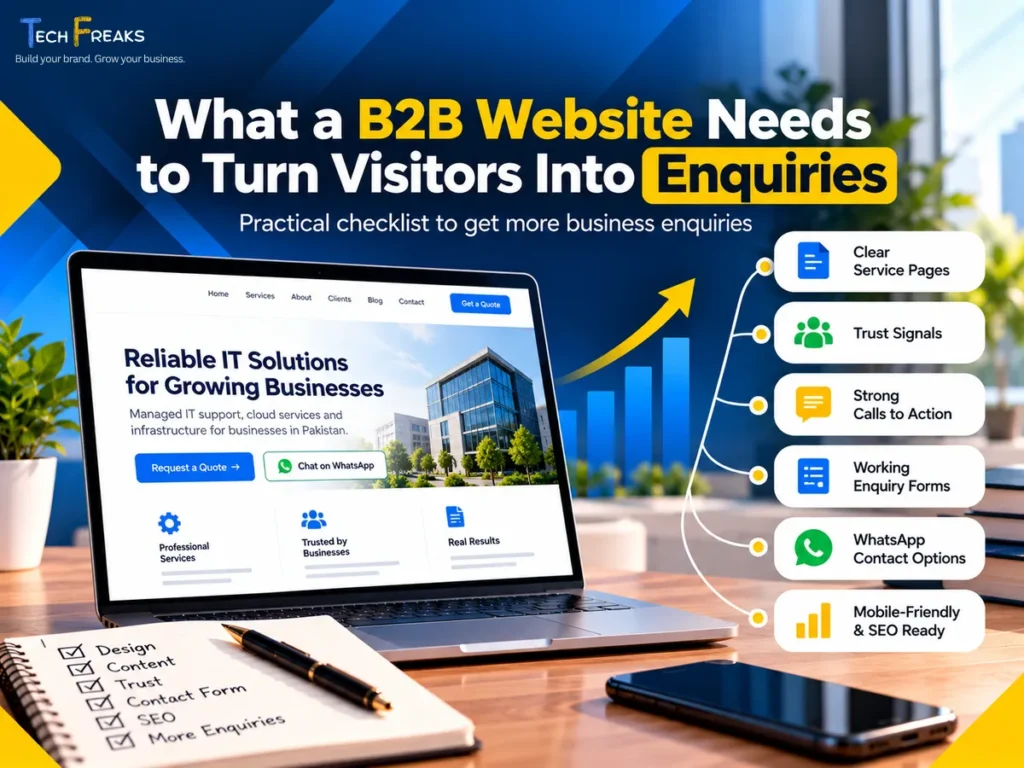
A business website should do more than explain what your company offers. It should help potential customers understand your services, trust your business, and take the next step toward working with you.
For many small and medium-sized B2B businesses in Pakistan, the challenge is not simply attracting website visitors. It is turning relevant visitors into genuine business enquiries.
Imagine a logistics company in Karachi, an industrial supplier in Lahore, or a recruitment agency in Islamabad. Potential customers may visit their websites to compare services, check credibility, or request quotations.
If they cannot quickly find the information they need, they may leave without getting in touch.
The solution is not necessarily a complete website redesign. Often, improving service explanations, navigation, contact options, and trust signals can make the website more useful.
In this guide, we explain the essential elements of a B2B website designed to support meaningful customer enquiries.
1. A Clear Headline That Explains Your Business
When someone visits your homepage, they should quickly understand what your business does and whether your services are relevant to them.
Avoid relying entirely on vague statements such as:
“We deliver innovative solutions for businesses.”
Although this sounds professional, it does not explain the actual service.
Instead, use a headline that communicates your offer and intended customer.
Example for an industrial supplier:
“Industrial Equipment and Maintenance Supplies for Businesses in Karachi”
Supporting text:
“Explore equipment and supply options for commercial facilities, workshops, and industrial operations. Contact our team to discuss your requirements.”
Call to action:
Request a Quotation
This is an illustrative example, not a claim about a real client or project.
An effective homepage introduction should answer three questions:
- What does your company provide?
- Who are your services intended for?
- What should an interested visitor do next?
Clear messaging helps visitors decide whether your company can meet their requirements.
2. Dedicated Pages for Your Main Services
One common website problem is placing every service on a single page without explaining what each service includes.
For B2B customers, service details often matter more than attractive design alone.
A company offering IT support, cloud services, and office network installation should consider creating separate pages explaining those services.
Each service page should cover:
- What the service includes
- Which businesses it is designed for
- Typical requirements or problems it addresses
- How the service is delivered
- What information customers need to request a quotation
For example, an office network installation page could explain network planning, equipment requirements, installation, configuration, and ongoing maintenance arrangements.
A customer looking specifically for network installation can then find relevant information without searching through unrelated content.
Dedicated service pages can also support organic search when they answer genuine customer questions.
TechFreaks offers Web Design & Development services focused on clear website structures, useful service content, and practical enquiry paths.
3. Trust Signals That Help Buyers Evaluate Your Business
B2B customers may need to evaluate a supplier before requesting a quotation or arranging a meeting.
Your website should help them determine whether your company is established, relevant, and approachable.
Useful trust signals include:
- An accurate company profile
- Genuine customer testimonials, where permission has been granted
- Approved client logos
- Verifiable certifications or industry memberships
- Real photographs of facilities, products, or staff
- Clearly explained service processes
- Accurate office and contact information
Avoid adding testimonials, customer names, or project results that cannot be substantiated.
If you display design concepts or demonstration projects, identify them as concepts rather than presenting them as completed client work.
For manufacturers and exporters: Product specifications, manufacturing capabilities, quality procedures, and genuine certifications may help buyers assess suitability.
For consulting and professional service businesses: Team expertise, service methodologies, qualifications, and clear engagement processes can provide useful context.
Trust comes from relevant, accurate information rather than exaggerated promises.
4. Strong Calls to Action on Important Pages
A visitor may understand your service and still leave because the next step is unclear.
A call to action, or CTA, tells the visitor what to do next.
For B2B service websites, useful examples include:
Get a Free Quote
Request a Consultation
Discuss Your Requirements
Send an Enquiry
Chat on WhatsApp
The right wording depends on what your business can actually offer.
A printing company may prefer “Request a Printing Quote,” while an IT consultancy may use “Discuss Your IT Requirements.”
Place your main CTA where it makes sense in the customer journey: near the homepage introduction, after important service information, and at the end of relevant pages.
Avoid overwhelming visitors with too many competing actions.
For example, if quotation requests are the main goal, make “Request a Quote” the primary action and WhatsApp a convenient alternative.
5. A Simple Enquiry Form That Actually Works
Your website’s contact form should make it easy for potential customers to explain what they need.
An unnecessarily complicated form can discourage people from submitting an enquiry.
For a general B2B service business, useful fields may include:
- Name
- Business name, if relevant
- Email address
- Phone or WhatsApp number
- Service required
- Short description of the requirement
Only make fields mandatory when the information is genuinely necessary.
For technical services or manufacturing quotations, additional details may be useful, but consider asking for them after the initial enquiry if appropriate.
A good form should also provide clear feedback.
When a visitor submits an enquiry, they should know whether the message was delivered successfully.
Before publishing your website, test the form on mobile and desktop.
Confirm that the correct business inbox receives the message, the confirmation appears, and the form does not silently fail.
For businesses using WordPress, form testing should be included in routine website maintenance, especially after major theme, plugin, or email configuration changes.
6. WhatsApp and Direct Contact Options
For businesses serving customers in Pakistan, WhatsApp can be a convenient communication option.
A visitor may prefer sending a quick message rather than completing a detailed form.
Your website can provide a direct WhatsApp link alongside your contact form.
However, make sure the displayed number is correct and that someone is responsible for responding.
For a B2B service company, WhatsApp should help start a useful conversation rather than replace all other contact methods.
An exporter communicating with international buyers, for example, may still need an email address for formal quotations, purchase orders, and documentation.
Offering both options allows customers to choose their preferred communication channel.
A useful website makes it easy to contact the business without forcing everyone into the same process.
7. Mobile-Friendly Design and Reliable Performance
Your website should be usable on smartphones, tablets, and desktop computers.
A potential customer may first discover your business through Google Search on a mobile phone and later review your services from an office computer.
The experience should remain clear across devices.
Check whether:
- Text is readable without zooming
- Navigation menus work correctly
- Buttons are easy to select
- Forms fit smaller screens
- Images do not obscure important content
- Contact details are accessible
- Pages load without unnecessary delays
You can use Google PageSpeed Insights to identify potential performance issues.
Common improvements include properly sized images, efficient code, sensible caching, and avoiding unnecessary scripts.
Do not focus exclusively on obtaining a perfect performance score.
The goal is a website that people can use comfortably and reliably.
8. Content That Answers Business Customers’ Questions
B2B customers often need more information before contacting a supplier.
Your website should answer the questions that matter when evaluating a service.
For example, a corporate training provider might explain its training subjects, delivery formats, intended participants, and how organizations can request a customized programme.
A packaging manufacturer might explain available materials, customization options, specifications, and quotation requirements.
Useful content could include:
- Service explanations
- Product specifications
- Frequently asked questions
- Ordering or onboarding processes
- Company capabilities
- Relevant educational articles
A blog can support this by addressing questions customers commonly ask before purchasing.
However, publishing articles simply to increase the number of pages is unlikely to create a strong customer experience.
Focus on content that serves your target audience.
For businesses wanting to improve how their services appear in search, explore TechFreaks’ SEO services.
9. Local Relevance Without Keyword Stuffing
A business website should accurately explain where services are available.
For example, a security services company operating in Karachi should clearly describe its actual service coverage.
An IT support company working with businesses in Lahore and Islamabad can explain how it delivers services in those locations, including whether support is remote or on-site.
Location-specific content is useful when it helps customers understand availability and service arrangements.
Avoid repeatedly inserting city names into headings or creating almost identical location pages without meaningful differences.
If your business serves customers in several cities, explain those service areas naturally.
For companies based in Pakistan but serving international customers, information about communication channels, time zones, and remote support can also be useful.
The objective is to answer genuine location-related questions, not to manipulate search rankings.
10. Clear Navigation and a Logical Website Structure
A visitor should not need to work hard to find basic business information.
A practical B2B website structure might include:
Home: A clear introduction and links to important services.
About: Company background, capabilities, and relevant credentials.
Services: Individual pages explaining the main offerings.
Work or Portfolio: Approved examples, clearly identified concepts, or genuine completed projects presented accurately.
Blog: Helpful articles answering customer questions.
Contact: A form, business contact details, and a direct enquiry option.
Not every business needs a large website.
A smaller site with useful, well-organized information can be more effective than a larger site filled with repetitive content.
Internal links should guide visitors naturally between related pages.
For example, an article about improving enquiries can link to a relevant website development service rather than directing readers to unrelated information.
11. Measure Enquiries, Not Just Website Traffic
Website traffic provides useful context, but visitor numbers alone do not explain whether your website is producing business opportunities.
Consider tracking meaningful customer actions such as:
- Successfully submitted enquiry forms
- WhatsApp button clicks
- Clicks to call or email
- Requests for quotations
- Qualified enquiries received
Google Analytics 4 can help measure website interactions.
For example, a successful enquiry form submission may be tracked using the recommended generate_lead event.
WhatsApp clicks can also be measured, but a click should not automatically be counted as a confirmed conversation or qualified lead.
Keep these stages separate.
A practical reporting approach is to review website visits, submitted enquiries, qualified leads, and confirmed business opportunities independently.
This helps you identify where improvements may be needed.
For businesses developing a broader marketing strategy, TechFreaks also provides Digital Marketing services.
12. Keep Your Website Updated and Functional
A website is not finished simply because it has been launched.
Business information changes. Services evolve. Contact details may need updating.
Regular checks help ensure that customers continue to receive accurate information.
Review your main service pages, contact details, forms, navigation links, and mobile experience periodically.
Check whether enquiries are reaching the correct team and whether important pages remain accessible.
If your website includes old project descriptions, expired offers, or outdated service information, update or remove them appropriately.
A maintained website gives potential customers a clearer picture of your business.
A Practical Example: Improving a B2B Service Website
Consider a hypothetical recruitment company in Islamabad.
Its homepage has a generic headline, a long paragraph about the company, and a contact link hidden in the footer.
A clearer version could include the following structure.
Homepage headline:
“Recruitment and Staffing Support for Businesses in Islamabad”
Supporting description:
“Find recruitment support for permanent hiring, contract staffing, and business workforce requirements.”
Primary CTA:
“Discuss Your Hiring Requirements”
Supporting sections:
An overview of recruitment services, the types of hiring supported, the engagement process, genuine company credentials, and commonly asked questions.
Contact section:
A short enquiry form requesting company details, hiring requirements, and a preferred contact method.
This example illustrates how clearer messaging and a simpler customer journey can improve the usefulness of a B2B website. It is not a real client case study or a claim of measured results.
Quick B2B Website Enquiry Checklist
Before deciding whether your business website needs a complete redesign, review these essentials.
| Website element | What to check |
|---|---|
| Homepage message | Is it clear what the company offers? |
| Service pages | Are individual services explained properly? |
| Trust signals | Are company details and proof genuine? |
| Calls to action | Can visitors easily request a quote? |
| Enquiry form | Does submission work successfully? |
| Does the link open the correct number? | |
| Mobile experience | Can customers navigate and contact you easily? |
| Performance | Do important pages load reliably? |
| SEO | Can search engines access useful service content? |
| Analytics | Are meaningful enquiries measured? |
You do not need to change everything at once.
Start with issues that make your services difficult to understand or prevent customers from contacting you.
Frequently Asked Questions
What makes a good B2B website?
A good B2B website explains its services clearly, provides trustworthy business information, and gives potential customers an easy way to make an enquiry. It should also work reliably on mobile devices and answer relevant buyer questions.
How can I get more enquiries from my business website?
Start by reviewing your homepage messaging, service pages, contact forms, and calls to action. Make sure people understand what you offer and can easily request a quotation. Use analytics and real enquiry feedback to identify additional improvements.
Is SEO important for a B2B website?
SEO can help relevant customers discover your services through organic search. However, search visibility should be supported by useful content and a clear enquiry process. Higher traffic alone does not guarantee qualified leads.
Does every B2B business need a large website?
No. Website size depends on the services, products, and information customers need. A focused website with useful pages can be sufficient for a smaller business, while complex manufacturers or service providers may need more detailed content.
Should I add WhatsApp to my B2B website?
WhatsApp can provide a convenient contact option, especially for businesses whose customers prefer direct messaging. It should be monitored and should complement other appropriate channels such as email and enquiry forms.
Should I redesign my website if I am not receiving enquiries?
Not necessarily. First check whether the website attracts relevant visitors, explains services clearly, and has working contact options. Targeted improvements may address the problem without requiring a full redesign.
Final Thoughts
A successful B2B website is not simply about attractive visuals or having more pages.
It should make your business easier to understand, easier to evaluate, and easier to contact.
For businesses in Karachi, Lahore, Islamabad, Rawalpindi, and beyond, practical website improvements can support a stronger online presence and a clearer path from visitor interest to business enquiry.
Start with the basics: accurate messaging, dedicated service pages, genuine trust signals, working contact methods, and an experience that works across devices.
Then use feedback and measurable enquiries to guide future improvements.
Need a B2B Website Built Around Your Business?
At TechFreaks, we help businesses plan, design, develop, and improve websites around their services and customer needs.
Our approach is practical and transparent, following a clear process: Discover, Plan, Design, Build, Launch, and Support.
Whether you’re building a new business website or improving an existing one, we can help you identify the right next step.
Explore our Web Design & Development services, or contact us to discuss your requirements.
Build your brand. Grow your business.
Chat with TechFreaks on WhatsApp
Further Reading
Google Search Central — Creating Helpful, Reliable, People-First Content